
A wheelbarrow is usually the better pick when you need tight turning, controlled dumping, and frequent trips over uneven garden ground. A garden cart is often easier for bulky loads, longer hauls, and users who value stability over pinpoint maneuverability.
At a Glance: Match the Hauler to the Job. Choose by what you move most often, how rough or narrow your route is, how much lifting and balancing you can comfortably manage, and where the tool will live between projects. A stable cart can reduce the effort of balancing a load, while a traditional single-wheel wheelbarrow remains hard to beat for narrow paths and precise tipping.
Start With the Work You Actually Do
The wheelbarrow-versus-cart decision becomes much easier when you ignore marketing labels and picture three ordinary weekends in your yard. Are you moving mulch into narrow beds, hauling rocks across a broad lawn, carrying potted plants from a garage, or collecting leaves along a long driveway? The best tool is the one that fits those repeated routes and materials.
Virginia Cooperative Extension advises gardeners to choose a wheelbarrow or cart that is easy to handle when full and appropriate for the user's physical abilities and garden needs. Its garden equipment guidance also notes that wheelbarrows generally demand more strength and control than many garden carts. That distinction matters more in daily use than a dramatic capacity claim on a product tag.
A useful first step is to estimate the heaviest material you routinely move, then consider the path rather than the destination. Loose mulch is bulky but relatively forgiving. Soil, wet compost, gravel, pavers, and logs become tiring quickly. A route with gates, sharp corners, roots, steps, or slopes favors different handling characteristics than a wide paved path.
How Wheelbarrows and Garden Carts Behave Differently
| Decision Factor | Wheelbarrow | Garden Cart |
|---|---|---|
| Tight paths and sharp turns | Strong fit, especially single-wheel designs | Better when the path is wide enough for the wheelbase |
| Precise dumping | Excellent for soil, mulch, and compost | Depends on whether the cart has a dump bed |
| Stability at rest | Must be set down on legs or supports | Usually stable on multiple wheels |
| Balancing effort | Higher on single-wheel models | Usually lower because more of the load is supported by wheels |
| Bulky objects | Can be awkward in a deep tray | Often easier in an open or flat cart bed |
| Storage footprint | Often narrower but may be tall | Can require more floor area depending on wheelbase |
A classic wheelbarrow typically carries its tray over one front wheel, with two handles extending toward the user. That geometry lets you pivot closely around beds and tip material exactly where you want it, but you support and balance part of the load while moving. Two-wheel wheelbarrows trade some of that pivoting agility for greater side-to-side stability.
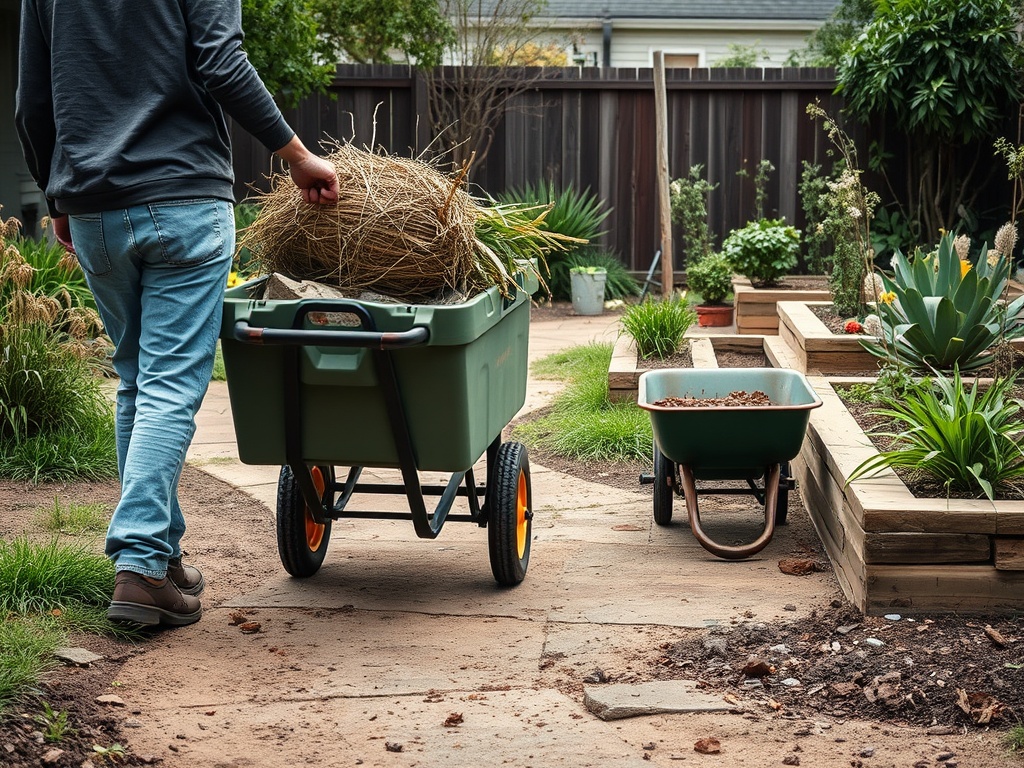
Garden carts commonly use two or four wheels and carry the load lower. Many models are pushed or pulled with less balancing effort, and wagon-style carts can be convenient for tools, plants, bags, and awkward objects. Some dump carts tilt their bed; others are better treated as transport platforms that you unload by hand.
Terrain Changes the Answer
On narrow garden paths, a single-wheel wheelbarrow can track through spaces that a wide cart cannot. It can also place a load beside a raised bed without forcing you to approach straight on. That makes it useful when your yard has established planting areas, tight corners, and many short delivery points.
A cart tends to feel calmer on broad lawns, driveways, and flatter routes because multiple wheels carry and stabilize the load. Larger pneumatic tires may roll more smoothly over rough ground, while solid or flat-free tires remove inflation maintenance but may transmit more bumps. Tire type, wheel diameter, and ground clearance can matter as much as the number of wheels.
Rutgers Cooperative Extension recommends reducing strain in the garden by using carts where appropriate, pushing rather than pulling when practical, and keeping loads within what you can comfortably manage. Its ergonomic gardening guidance is a useful reminder that the physically easiest option may be more valuable than the one with the highest theoretical capacity.
Think About Loading and Unloading, Not Just Hauling
A wheelbarrow shines when the last motion is a controlled tip. You can roll mulch to a bed, lift the handles, and pour the load into a compact area. The same motion may be less comfortable with dense material, especially if the load shifts suddenly or the ground under your feet is uneven.
A garden cart can be easier to load because the bed often sits lower and stays level. That is helpful for bags of soil, watering cans, flats of seedlings, firewood, or tools you do not want sliding together. If the cart does not dump, however, you may save effort while hauling only to spend more time lifting each item out. For repeated bulk-material work, a real dump mechanism deserves extra weight in the decision.
If you are building or tending beds, the related guide How to Light a Patio for Ambiance and Safety is a useful example of planning a yard project around routes, obstacles, and how people actually move through the space. The same practical thinking applies to hauling equipment.
A Simple Decision Framework
Choose a single-wheel wheelbarrow if narrow access, sharp turns, and precise dumping are your main needs and you are comfortable balancing the load. Choose a two-wheel wheelbarrow if you still want a tipping tray but prefer more side-to-side stability.
Choose a two- or four-wheel garden cart if you often haul bags, tools, potted plants, firewood, or bulky items over wider routes. A dump cart is especially useful if loose material is common and you want the stability of a cart without giving up easy unloading.
Before committing, test the handle height and grip position if possible. Lift an empty model, turn it in a realistic radius, and imagine the movement with a load. Check whether you can store it without dismantling it. Product capacity should never be treated as a target; manufacturer limits, terrain, load balance, and your own comfort all matter.
The Better Choice Is the One You Can Control
For many small or densely planted yards, a wheelbarrow remains the most versatile all-purpose hauler. For larger properties, longer paths, frequent bulky loads, or anyone who dislikes balancing weight, a garden cart can be the more comfortable choice. There is no universal winner because wheel layout, tray shape, terrain, and user strength change the experience.
If your home projects frequently move from garden work to repair work, How to Refinish a Wood Table Top at Home offers a complementary way to think about matching tools to the task rather than buying for occasional edge cases. Start with your regular workload, then choose the simplest hauler that makes those jobs safer and easier to repeat. The same preventive mindset appears in The Most Overlooked Home Maintenance Tasks, where small inspections help keep tools and household systems ready for use.
This article is for general informational purposes. Follow the equipment manufacturer's load, tire, assembly, and safety instructions, and adapt lifting or hauling tasks to your physical abilities and site conditions.[/